Why Glute Training Matters
The glutes are the largest and most powerful muscle group in the human body, yet they're chronically underworked in most women's training programs. Strong glutes aren't just about aesthetics. They're the engine behind nearly every athletic movement: running, jumping, lifting, and even walking efficiently.
From a postural standpoint, weak glutes contribute directly to anterior pelvic tilt, the forward tip of the pelvis that causes lower back pain, tight hip flexors, and poor squat mechanics. Strengthening your glutes literally corrects your posture over time.
Research by Contreras et al. (2015) using electromyography (EMG) confirmed that targeted glute exercises generate significantly higher glute muscle activation than general compound movements alone, making specific exercise selection critical if glute development is your goal.
Glute Anatomy: Know What You're Training
The gluteal complex is made up of three distinct muscles, each with a different function:
- Gluteus Maximus: The largest of the three. Responsible for hip extension (driving the hips forward), external rotation, and hip abduction in extended positions. This is the muscle most visible and most targeted in training. Hip thrusts, squats, and deadlifts primarily work this muscle.
- Gluteus Medius: Located on the outer surface of the pelvis. Critical for hip abduction (lifting the leg sideways) and pelvic stability during walking, running, and single-leg movements. Weakness here causes the "Trendelenburg drop", the hip sagging on the standing leg. Clamshells and lateral band walks target this muscle.
- Gluteus Minimus: The smallest and deepest of the three. Works in synergy with the medius to stabilize the pelvis and assist in abduction and internal rotation. Rarely isolated directly but trained through the same movements as the medius.
Effective glute programming trains all three, not just the maximus through hip extension, but the medius and minimus through abduction and stabilization work.
The 5 Best Glute Exercises for Women
1. Hip Thrust (Barbell or Bodyweight)
The hip thrust is, without question, the king of glute exercises. Contreras et al. (2015) measured glute EMG activation across dozens of exercises and found that the barbell hip thrust consistently produced the highest gluteus maximus activation of any movement tested, often exceeding 100% of maximal voluntary contraction (MVC).
Setup: Sit on the floor with your upper back against a bench. Place a barbell across your hips (use a pad for comfort). Plant your feet flat on the floor, hip-width apart, with knees at roughly 90 degrees at the top position. Drive your hips up by squeezing your glutes hard, creating a straight line from shoulders to knees. Hold the top for 1–2 seconds. Lower with control.
- Bodyweight beginner: 3 sets × 15–20 reps, focus entirely on the squeeze at the top
- Loaded intermediate: 4 sets × 8–12 reps, add weight progressively each session
- Key cue: Tuck your chin and don't hyperextend the lower back. The movement comes from the hips, not the spine.
2. Romanian Deadlift (RDL)
The RDL is a hinge pattern that targets the posterior chain, primarily the hamstrings and glutes, through a large range of motion. Unlike conventional deadlifts, the bar stays close to your body as you hinge at the hips with a soft bend in the knees, loading the glutes and hamstrings under a deep stretch.
The stretched position at the bottom is where the most mechanical tension is generated, making the RDL one of the most effective exercises for overall posterior chain development.
- Sets/Reps: 3–4 sets × 8–12 reps
- Key cue: Push your hips back, not down. Feel the stretch in the back of your legs. Keep a neutral spine throughout, no rounding the lower back.
- Progressive overload: Add 2.5kg to each side when you can complete all reps with perfect form.
3. Bulgarian Split Squat
The Bulgarian split squat is a unilateral exercise, meaning each leg works independently, which forces greater balance, stability, and muscle recruitment than bilateral exercises. Research shows unilateral movements produce higher glute activation relative to bodyweight than bilateral squats, and they also address side-to-side strength imbalances.
Setup: Stand about 2 feet in front of a bench. Reach one foot back and rest the top of your foot on the bench. Lower your body until the back knee hovers just above the floor, keeping the front shin as vertical as possible. Drive through the front heel to return to standing.
- Sets/Reps: 3 sets × 8–10 reps per leg
- Key cue: Keep your torso upright and your front knee tracking over (not collapsing past) your toes. Lean slightly forward to shift emphasis toward the glutes rather than the quads.
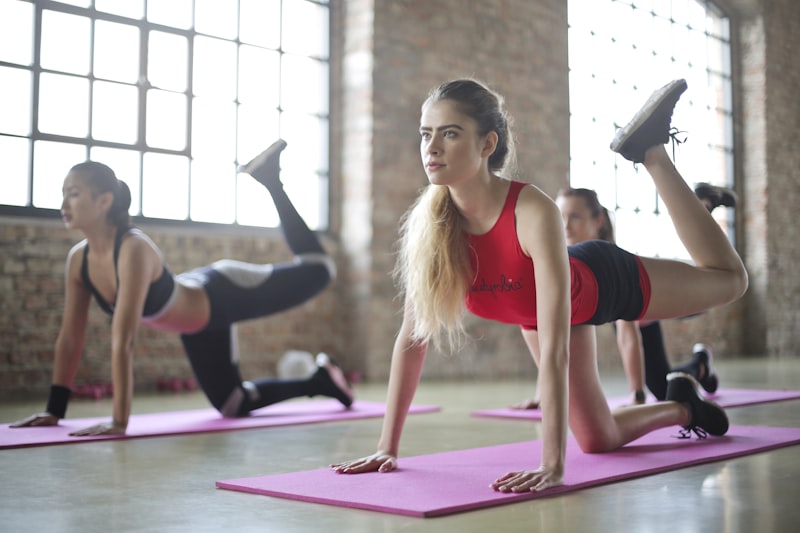
4. Cable Kickback
The cable kickback is an isolation exercise that keeps constant tension on the glutes throughout the entire range of motion, unlike free weights, which lose tension at certain points. This makes it an excellent accessory movement for targeting the gluteus maximus with a strong mind-muscle focus.
- Sets/Reps: 3 sets × 12–15 reps per leg
- Key cue: Hinge slightly at the hips and brace your core. Drive the leg back and up using your glute, not your lower back. Squeeze hard at the top for 1 second. Keep the movement controlled and deliberate.
- Mind-muscle tip: Before beginning, hold the contracted position for 5 seconds to establish the neuromuscular connection.
5. Sumo Squat / Wide-Stance Squat
The sumo squat uses a wider stance with toes pointed significantly outward (45–60 degrees). This positioning shifts more of the load onto the inner glutes (specifically the gluteus medius and the hip adductors), providing a different stimulus than hip-width squat variations.
- Sets/Reps: 3 sets × 12–15 reps
- Key cue: Push your knees out in line with your toes throughout the movement. Descend until your thighs are at least parallel to the floor. Hold a dumbbell or kettlebell vertically for added resistance (goblet sumo squat).
Sample Weekly Structure (2x/Week Glute Focus)
Training glutes twice per week with at least 48 hours of recovery between sessions is supported by the hypertrophy research as the optimal frequency for most women.
Session A (Hip-Dominant Focus)
- Barbell Hip Thrust, 4 × 8–10
- Romanian Deadlift, 3 × 10–12
- Cable Kickback, 3 × 12–15 each side
- Clamshells (activation finisher), 2 × 20 each side
Session B (Squat & Unilateral Focus)
- Bulgarian Split Squat, 3 × 8–10 each leg
- Sumo Goblet Squat, 3 × 12–15
- Hip Thrust (bodyweight, pause reps), 3 × 15
- Banded Lateral Walk, 2 × 12 each direction
Common Mistakes to Avoid
- Going too heavy too soon: When load exceeds your control, the quads, lower back, and hamstrings compensate. You feel the workout, but not in your glutes. Start lighter than you think you need to.
- Skipping the activation warm-up: Cold, dormant glutes won't fire effectively during heavy compound work. 5 minutes of bodyweight bridges, clamshells, and banded walks makes a measurable difference.
- Neglecting the eccentric (lowering) phase: The lowering phase generates significant mechanical tension. Don't just drop the weight, control the descent for 2–3 seconds.
- Only doing squats: Squats are primarily quad-dominant. If your training is 80% squats, you're leaving glute gains on the table. Hip thrusts must be a staple.
- Inconsistent progressive overload: Doing the same weight and reps every session leads to zero adaptation after the first few weeks. Track your sessions and aim to add weight or reps every 1–2 weeks.
Progressive Overload for Glute Growth
Progressive overload is the single most important variable in long-term muscle development. Without progressively increasing the demand placed on your muscles, adaptation stalls. Practical methods include:
- Add weight: When you can complete all reps with perfect form, add 2.5–5kg at the next session.
- Add reps: If you're at 3 × 8, work up to 3 × 12 before increasing weight.
- Add sets: Increase from 3 to 4 working sets on a key exercise.
- Improve tempo: Slow down the eccentric (3 seconds down) or add a 2-second pause at the top of a hip thrust.
Track every session in a notebook or app. Progress only looks linear over months, week to week it's messy, but the trend must go up.
Sources & Further Reading
- Contreras, B. et al. (2015). A comparison of gluteus maximus, biceps femoris, and vastus lateralis electromyographic activity in the back squat and barbell hip thrust exercises. Journal of Applied Biomechanics, 31(6). PubMed
- Schoenfeld, B.J. (2010). The mechanisms of muscle hypertrophy and their application to resistance training. Journal of Strength and Conditioning Research, 24(10). PubMed
- Calatayud, J. et al. (2018). Importance of mind-muscle connection during progressive resistance training. European Journal of Sport Science. PubMed