Why Leg Day Is Non-Negotiable
The lower body contains the largest muscle groups in the human body, the quadriceps, hamstrings, glutes, and calves collectively make up roughly 60% of your total muscle mass. Training them consistently triggers a significant hormonal response: studies show that heavy compound lower body exercises like squats and deadlifts stimulate greater acute elevations in testosterone, growth hormone, and IGF-1 than upper body exercises matched for total volume.
Beyond hormones, leg training improves bone density, joint health, metabolic rate, and functional capacity, your ability to perform everyday movements like climbing stairs, lifting objects from the floor, and maintaining balance as you age. Skipping leg day isn't just an aesthetic mistake; it's a long-term health compromise.
Schoenfeld (2010) identified the three primary mechanisms of muscle hypertrophy, mechanical tension, metabolic stress, and muscle damage, and the lower body, with its large muscle masses and capacity for heavy loading, is uniquely positioned to maximize all three simultaneously.
Lower Body Anatomy: Know Your Muscles
A complete leg day targets all major lower body muscles. Here's what you're working with:
- Quadriceps (4 heads): Rectus femoris, vastus lateralis, vastus medialis, vastus intermedius. The primary knee extensors. Heavily engaged in squats, leg press, and lunges. The rectus femoris also crosses the hip, making it active in hip flexion.
- Hamstrings (3 heads): Biceps femoris (long and short head), semitendinosus, semimembranosus. Responsible for knee flexion and hip extension. The RDL and leg curl are the primary hamstring developers.
- Gluteus Maximus: The largest muscle in the body. Powers hip extension. Most activated by hip thrusts and deep squats.
- Calves (2 muscles): Gastrocnemius (two-headed, crosses the knee) and soleus (below the gastrocnemius). Responsible for plantarflexion (pointing the foot). Trained with calf raises in both straight-leg and bent-knee positions.
- Adductors: The inner thigh muscles that bring the legs together. Engaged during sumo squats, wide-stance movements, and dedicated adductor machine work.
Warm-Up Protocol (10 Minutes)
Never walk into a heavy leg session cold. A proper warm-up increases core temperature, improves joint lubrication, activates dormant muscles, and reduces injury risk. Here's an evidence-based protocol:
Dynamic Mobility (5 minutes)
- Hip circles, 10 each direction: Loosens the hip capsule and improves squat depth.
- Leg swings (forward/back and lateral), 10 each direction per leg: Increases hamstring and hip flexor extensibility.
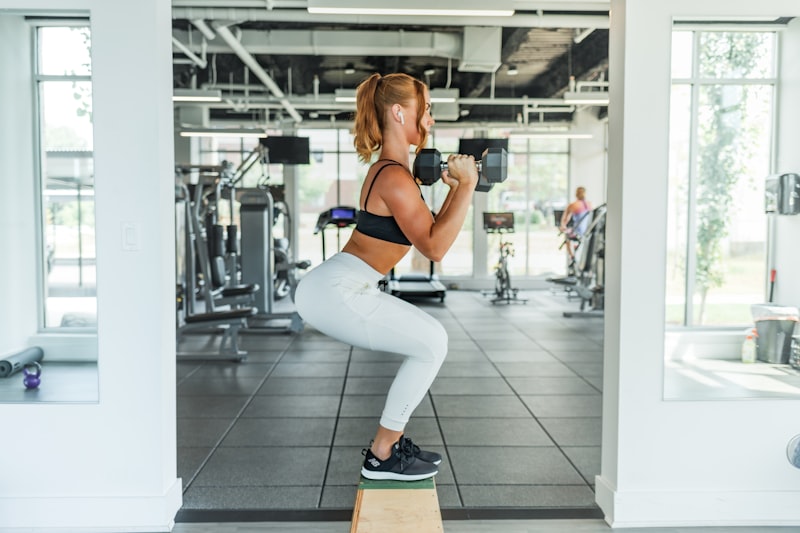
- Deep squat hold, 2 × 30 seconds: Mobilizes ankles, hips, and thoracic spine simultaneously.
- Walking lunges, 10 steps: Warms up the entire lower body through movement.
Muscle Activation (5 minutes)
- Glute bridges, 2 × 15: Wakes up the posterior chain before heavy hip extension movements.
- Clamshells with band, 2 × 15 per side: Activates the gluteus medius for pelvic stability.
- Bodyweight squats with 3-second pause at bottom, 2 × 10: Rehearses the squat pattern under no load.
The Complete Leg Day Workout
Main Lifts, Strength & Hypertrophy Foundation
These compound movements form the backbone of the session. They require the most neural demand and should be performed first, when energy and focus are highest.
- Back Squat, 4 × 6–8 reps @ RPE 8
The foundational lower body movement. Use a full range of motion (thighs parallel or below). Rest 2–3 minutes between sets. The 6–8 rep range develops both strength and hypertrophy simultaneously. - Romanian Deadlift, 4 × 8–10 reps @ RPE 8
Primary posterior chain developer. Hinge at the hips with a soft knee bend, feeling the stretch in your hamstrings at the bottom. Keep the bar close to your body. Rest 2 minutes between sets.
Secondary Compounds, Volume Accumulation
- Leg Press, 3 × 12 reps @ RPE 7
Allows high quad volume without spinal loading. Use a shoulder-width foot placement for balanced quad/glute activation. Do not lock out fully at the top. Rest 90 seconds between sets. - Walking Lunges, 3 × 12 reps per leg
Unilateral movement that addresses balance, coordination, and side-to-side strength asymmetries. Hold dumbbells at your sides for resistance. Keep torso upright and front knee aligned with the middle toe. Rest 90 seconds between sets.
Accessory Work, Targeted Isolation
These movements complete the session by targeting muscles that may not be fully exhausted by the compounds, and by accumulating metabolic stress for hypertrophy.
- Lying Leg Curl, 3 × 12 reps
Isolates the hamstrings through knee flexion. Control the eccentric (extension) phase for 2–3 seconds. Rest 60 seconds between sets. - Leg Extension, 3 × 15 reps
Isolates the quadriceps. Most effective at shorter rest periods (60 seconds) to accumulate metabolic stress and the "pump" that drives additional hypertrophy. - Calf Raises (standing and seated), 4 × 15 reps each
Standing calf raises target the gastrocnemius; seated calf raises (with bent knee) target the soleus. Both are needed for complete calf development. Pause at the top for 1 second and lower slowly.
Cool-Down Stretches (5–10 minutes)
- Standing quad stretch, 30 seconds per leg
- Seated hamstring stretch, 30 seconds per leg
- Figure-4 glute stretch, 30 seconds per side
- Hip flexor lunge stretch, 30 seconds per side
- Calf stretch against wall, 30 seconds per leg
Sets, Reps & The Science Behind the Ranges
The rep ranges in this workout are deliberate. Research distinguishes between two primary training goals:
- Strength (1–6 reps, heavier loads): Primarily develops neural efficiency, how many motor units your brain can recruit simultaneously. Builds density and maximizes mechanical tension.
- Hypertrophy (6–20 reps, moderate loads): The optimal range for muscle size development. Schoenfeld's research shows that a range of 6–20 reps, taken close to failure, produces near-equivalent hypertrophy regardless of specific rep count, what matters is proximity to failure, not the rep number.
- Metabolic/Endurance (15–30 reps, lighter loads): Used for isolation work to accumulate volume and metabolic stress without additional joint stress.
The compound lifts in this program sit in the strength-hypertrophy overlap (6–12 reps), while accessory work targets the metabolic range (12–20 reps).
Frequency Recommendations
For most women, training legs 1–2 times per week with at least 72 hours between sessions is the optimal balance of volume and recovery. Once per week provides sufficient stimulus for beginners; twice per week (common in push/pull/legs or upper/lower splits) allows more weekly volume and is appropriate for intermediate to advanced trainees.
If training twice per week, vary the emphasis: one session can be squat-dominant (more quad focus), the other hinge-dominant (more posterior chain focus).
Common Leg Day Mistakes
- Rushing the warm-up or skipping it entirely: Cold muscles are injury-prone muscles. The 10-minute warm-up protocol above is not optional, it's structural to the session.
- Ego lifting (using more weight than technique allows): A half-rep squat with 80kg builds less muscle than a full-depth squat with 60kg. Range of motion matters. Technique matters.
- Skipping unilateral work: Walking lunges and split squats expose strength imbalances between legs and develop proprioception that bilateral movements cannot. They belong in every program.
- Neglecting posterior chain: Many beginners default to leg press and leg extensions, both of which are quad-dominant. The hamstrings and glutes need equal, if not greater, attention. Include RDLs and leg curls every session.
- Not tracking progressive overload: If you're doing the same weight and reps as three months ago, you haven't made three months of progress. Log every session.
Recovery: What Happens After You Leave the Gym
Muscle growth doesn't occur during training, it occurs during recovery. The training session is the stimulus; sleep, nutrition, and rest are the response. Key recovery factors:
- Sleep: 7–9 hours per night is the evidence-backed range for optimal muscle protein synthesis and hormonal recovery. A single night of poor sleep reduces testosterone and growth hormone secretion by up to 15%.
- Protein: Consume 1.6–2.2g of protein per kilogram of bodyweight per day, distributed across 3–5 meals. Post-workout protein (within 2 hours) is beneficial but not as critical as total daily intake.
- Managing DOMS: Delayed onset muscle soreness peaks 24–72 hours after training. Light movement (a 20-minute walk) accelerates blood flow and reduces soreness perception. Avoid training the same muscles intensely while severely sore.
Sources & Further Reading
- Schoenfeld, B.J. (2010). The mechanisms of muscle hypertrophy and their application to resistance training. Journal of Strength and Conditioning Research, 24(10). PubMed
- Schoenfeld, B.J., Grgic, J. et al. (2017). Dose-response relationship between weekly resistance training volume and increases in muscle mass. Journal of Sports Sciences. PubMed
- Morton, R.W. et al. (2018). A systematic review, meta-analysis and meta-regression of the effect of protein supplementation on resistance training-induced gains in muscle mass and strength. British Journal of Sports Medicine, 52(6). PubMed