The training session creates the signal for muscle growth. What you eat in the hours that follow determines whether your body actually builds anything. Most women focus obsessively on the workout and treat post-training nutrition as an afterthought.
What Is Actually Happening After You Train
During a resistance training session, muscle protein breakdown (MPB) accelerates. The mechanical stress of lifting tears muscle fibers at a microscopic level, triggering an inflammatory and repair cascade. The moment you rack the bar, your body begins shifting from a catabolic state toward an anabolic one, but only if sufficient nutrition is available to drive that shift. Without protein arriving within a reasonable window, MPB continues to outpace muscle protein synthesis (MPS) and you end up net negative: you broke down more than you built.
The post-workout window is real, but it is considerably wider than the fitness industry once claimed. Research shows that MPS remains elevated for up to 24 to 48 hours post-training, not just the first 30 minutes after you leave the gym. What matters most is not hitting an exact timestamp but the quality and quantity of protein and carbohydrates consumed within that extended window.
Protein First — The Non-Negotiable
The single most important post-workout nutrient is protein. Aim to consume 25 to 40 grams of high-quality protein within 2 hours of finishing training. This range is sufficient to maximally stimulate MPS in most women. Body mass and training volume push the upper end of that range: lighter women doing moderate volume may saturate MPS at 25g, while heavier women or those doing high-volume sessions benefit from pushing toward 40g.
Moore et al. (2009) demonstrated that 20g of protein maximally stimulated muscle protein synthesis in younger women following resistance exercise, with no additional MPS benefit from consuming more. Heavier body mass or significantly greater training volumes may shift this threshold upward toward 30 to 40g.
The leucine content of your protein source matters as much as the gram total. Leucine is the key amino acid that activates the mTOR pathway, which acts as the primary switch for MPS. You need a minimum of 2.5 to 3g of leucine per meal to cross the threshold that maximally triggers mTOR. A 25g serving of whey protein delivers approximately 2.5g of leucine and clears this threshold reliably. Chicken breast, eggs, Greek yogurt, and cottage cheese all provide complete amino acid profiles with adequate leucine when consumed in reasonable serving sizes.
Ranked by leucine content and absorption speed, the top post-workout protein sources are: whey protein (fastest absorption, approximately 2.5g leucine per 25g serving), chicken breast (30g protein per 100g cooked), Greek yogurt (20g protein per 200g serving combining fast whey and slow casein fractions), whole eggs combined with egg whites (highly bioavailable, flexible macros), and cottage cheese (casein-dominant, slower release that works well when the next meal is still several hours away).
Carbohydrates After Training — Not Optional
Resistance training partially depletes muscle glycogen. The degree of depletion depends on session volume, intensity, and your pre-workout carbohydrate status, but even moderate lifting sessions reduce glycogen stores meaningfully. Carbohydrates post-workout serve two functions: they restore glycogen and they spike insulin. Insulin is anabolic. It drives amino acids into muscle cells and actively suppresses MPB. Combining protein with carbohydrates post-workout produces superior outcomes for both glycogen resynthesis and net muscle protein balance compared to protein consumed in isolation.
Target 0.5 to 1g of carbohydrate per kilogram of bodyweight within 2 hours post-training. For a 65kg woman training 4 times per week, this means 33 to 65g of carbohydrates in the post-workout meal. Higher-glycemic sources such as white rice, banana, oats, and sweet potato are particularly effective here because faster glucose delivery translates directly to faster glycogen resynthesis and a more pronounced insulin response.
What About Fat Post-Workout
Dietary fat slows gastric emptying, which in turn slows the rate at which protein and carbohydrates reach circulation. In the immediate post-workout window, specifically the first 2 hours, keeping fat intake below 15 to 20g helps avoid blunting the speed of protein delivery to muscle tissue. This is not a case against dietary fat. Fat is essential and beneficial throughout the rest of the day. It is a case for timing. A tablespoon of olive oil drizzled over chicken and rice is a non-issue. A high-fat meal such as salmon with half an avocado and a fatty dressing is better placed 3 to 4 hours after training when the urgency of glycogen resynthesis has passed.
5 Practical Post-Workout Meals
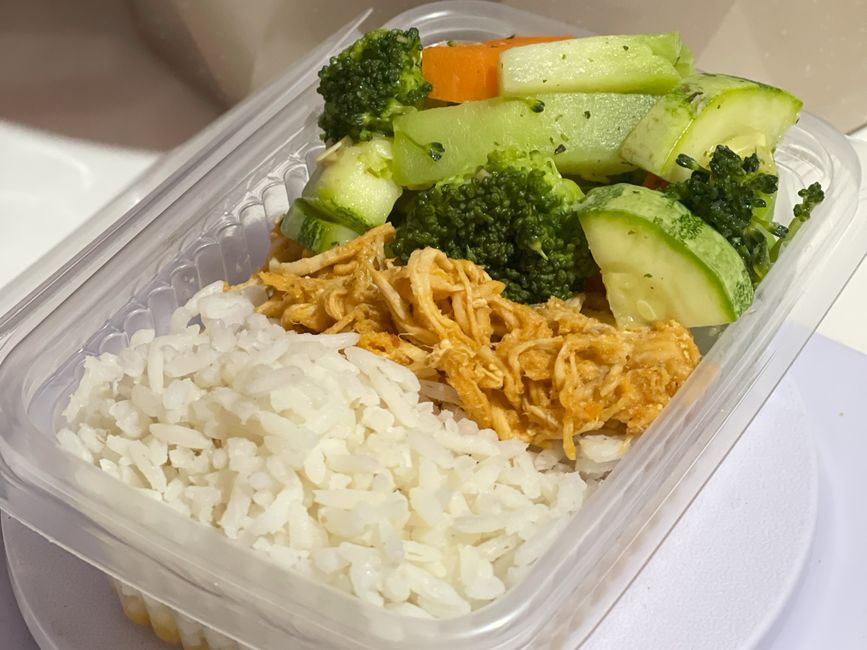
1. Chicken and white rice bowl. 150g cooked chicken breast + 200g cooked white rice + roasted vegetables. Approximately 480 kcal, 45g protein, 55g carbs, 8g fat. The classic for a reason: fast-absorbing carbohydrates paired with lean complete protein and a leucine load well above the mTOR threshold.
2. Greek yogurt and fruit. 250g full-fat Greek yogurt + 1 banana + 30g granola + 1 tablespoon honey. Approximately 420 kcal, 25g protein, 60g carbs, 8g fat. Fast, portable, and requires no cooking. Works particularly well after morning training sessions when appetite tends to be lower.
3. Whey shake and banana. 1 scoop whey protein (25g protein) blended in 300ml milk + 1 large banana. Approximately 380 kcal, 35g protein, 45g carbs, 6g fat. The fastest option available when appetite is suppressed immediately after training. Liquid protein and simple sugars clear into circulation faster than any solid food alternative.
4. Salmon rice bowl. 150g cooked salmon + 180g cooked jasmine rice + cucumber + edamame. Approximately 520 kcal, 42g protein, 50g carbs, 14g fat. Fat content sits slightly above the immediate-window ideal, making this meal better timed at 90 to 120 minutes post-training rather than immediately after finishing.
5. Egg and oat bowl. 3 whole eggs scrambled + 60g rolled oats cooked + berries + 1 teaspoon honey. Approximately 460 kcal, 30g protein, 55g carbs, 16g fat. Best suited to morning training sessions when a cooked breakfast fits naturally into the routine.
The Fasted Training Problem
A significant number of women train fasted, typically first thing in the morning before eating. For sessions lasting under 60 minutes at low to moderate intensity, fasted training is physiologically manageable. The incremental increase in MPB during a short fasted session does not create a deficit that cannot be addressed promptly afterward. For sessions exceeding 60 minutes or sessions that involve high intensity work, fasted training meaningfully amplifies MPB during the session itself, leaving you with a larger anabolic deficit to close once you finish.
In the fasted training scenario, the post-workout feeding window becomes more time-sensitive. Aim to consume protein within 30 to 45 minutes of ending the session rather than waiting for a full cooked meal. A fast-absorbing option such as a whey shake or Greek yogurt with fruit closes the deficit quickly and efficiently. Waiting another 90 minutes to cook a chicken and rice bowl after a fasted 75-minute training session is a recoverable but avoidable error.
How This Fits Into Total Daily Intake
The post-workout meal is not magic. It is one meal within the framework of a total daily protein and calorie target, and that total daily target remains the primary driver of muscle growth and recovery. If your daily protein target is 130g and the post-workout meal delivers 40g, you have 90g remaining to distribute across 3 to 4 other meals throughout the day. No single meal, regardless of its timing or composition, overrides chronic nutritional inadequacy. The post-workout window amplifies an already solid nutrition strategy. It cannot compensate for consistently low protein intake across the week.
Get daily protein right first. Then optimize the post-workout meal. In that order.
Sources & Further Reading
- Phillips SM et al. (1997). Mixed muscle protein synthesis and breakdown after resistance exercise in humans. Am J Physiol. https://pubmed.ncbi.nlm.nih.gov/9252485/
- Moore DR et al. (2009). Ingested protein dose response of muscle and albumin protein synthesis after resistance exercise in young men. Am J Clin Nutr. https://pubmed.ncbi.nlm.nih.gov/19056590/
- Ivy JL. (2004). Regulation of muscle glycogen repletion, muscle protein synthesis and repair following exercise. J Sports Sci Med. https://www.ncbi.nlm.nih.gov/pmc/articles/PMC3905295/
- Schoenfeld BJ, Aragon AA. (2018). Is there a postexercise anabolic window of opportunity for nutrient consumption? Blunting the myths and maximizing the realities. J Int Soc Sports Nutr. https://pubmed.ncbi.nlm.nih.gov/29462923/